
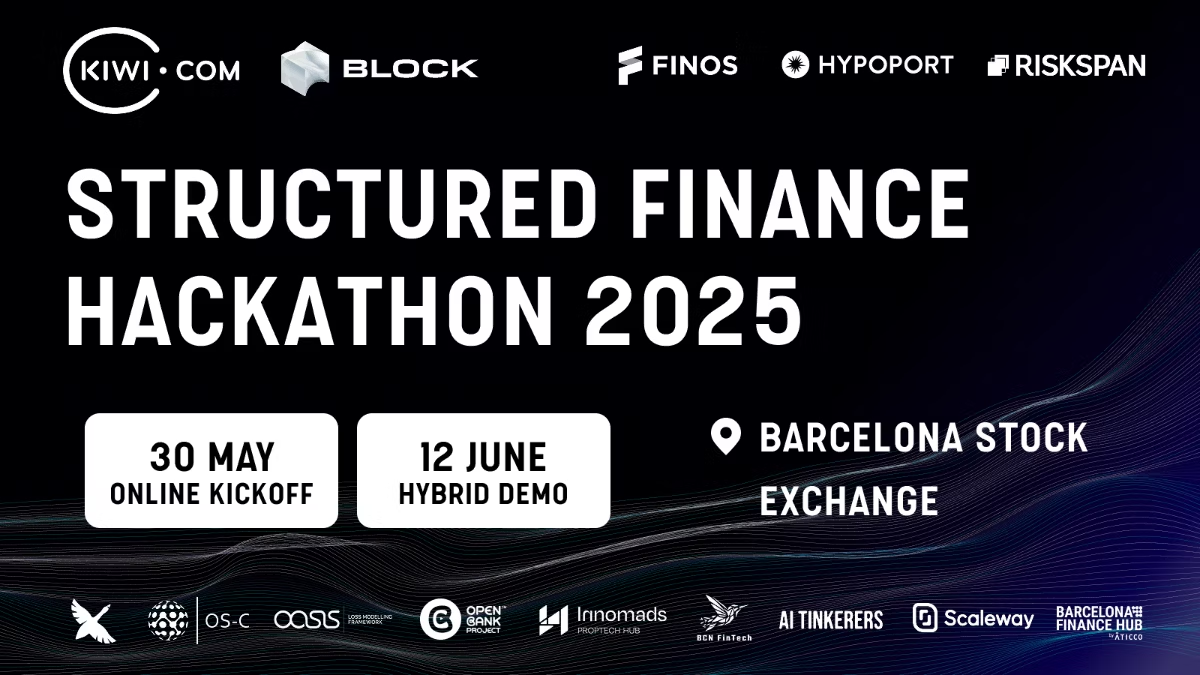
For an industry that still uses fax machines in places, “hackathon” might not be the word that gets most structured finance professionals out of bed in the morning. But the Structured Finance Hackathon 2025, which wrapped up in Barcelona on June 12, suggests that might soon change.
Held in the appropriate setting of the former Barcelona Stock Exchange, this hybrid gathering brought together developers and finance insiders to do something our industry rarely dares: build things quickly.
The result? Prototypes that make a strong case for a new generation of tools – and talent – in structured finance.
Below, I walk through the standout projects. If you’re wondering whether structured finance could ever get a little more modern, a little more intelligent (and yes, a little faster), the following might convince you it’s on the right track.
Climate Risk Insights of Dutch Mortgage Portfolios
🏆 First Place Winner
It’s hard to make the phrase “Dutch mortgage climate exposure” sound exciting, unless you’ve just built a multi-agent AI system that reads loan books, cleans zipcode data, assesses regional flood risk, and turns all that into a dashboard that makes sense.
This team did just that, targeting the €800bn blind spot in Dutch mortgage risk: climate events like the 2021 Limburg floods that banks didn’t price for.
This smart orchestration of agents (data reader, zipcode processor, climate calculator, dashboard generator) can help banks identify key vulnerabilities in mortgage portfolios before climate events occur.
AI-DRRD – AI-Powered Disaster Risk Resilience Dashboard
🥈 Second Place (Tied)
This is another dashboard you wish you had in 2021: a risk dashboard with multiple hazard types, property-level detail, scenario modelling, and automated regulatory reporting. AI-DRRD connects climate data, even real-time weather information, with loan portfolios in a way that’s granular, visual, and financially legible.
The AI-DRRD visualizes climate risks at the property level to enable more accurate loan pricing and effective risk mitigation. The AI Assistant provides real-time guidance on mitigation strategies and overall portfolio optimization.
It wasn’t just the tech that stood out. The presenter behind AI-DRRD delivered one of the most memorable demos of the day. Anchored in a sharp understanding of both climate risk and financial impact, her storytelling made a complex tool approachable. A reminder that how you explain the solution can be just as important as the solution itself.
Credit Goose – Smarter Invoice Financing with Agents
🥈 Second Place (Tied)
For anyone on the lending or credit side who’s seen promising SMEs fall through the cracks due to inadequate scoring engines, Credit Goose offers a pragmatic fix.
The platform uses a Goose-powered AI agent to score invoices based on both financial and public data in just 45 seconds. SMEs connect CreditGoose to their ERP to retrieve unpaid invoices, the agent then evaluates the risk score and enables financing to be disbursed in 24 hours.
- SMEs can set up auto-finance for eligible invoices based on certain criteria
- 3-stage scoring framework: Qualification Filter, Risk Bucketing, Intelligent Scoring
- Real-time Web Search using Gemini LLM to find updated public information
- Admin panel for tweaking queries without touching code
InvoiceAccelerator – Headless AI for Structured Workflows
InvoiceAccelerator exposes a Goose-based agent service as a HTTP API. Its LLM backend is Groq-powered for low-latency inference (yes, that’s the same Groq from the AI speed demo videos), and it turns invoices, borrower data, and risk parameters into financing decisions.
The team focused on integration over interface. By exposing everything via a clean API, the system is UI-agnostic, ready to plug into an existing dashboard or support a custom-built interface. This is a B2B SaaS backend in the making: composable, pluggable, and with no frontend dependencies.
Issuria – Natural Language to PRIIPs KID
Ever wanted to type “3-year note on tech stocks with 8% max return” and get a compliant Key Information Document (KID) back? This submission makes that possible. Issuria’s AI-powered assistant takes plain language product specs and spits out export-ready documents.

You can try it out here! https://www.issuria.com/
With integration-ready CLI tools, HuggingFace-hosted datasets tailored to ESMA/CDM benchmarks, and a multi-agent backend coordinating compliance, structuring, and product creation, Issuria cuts down the issuance cycle from weeks to minutes.
- Converts freeform product descriptions to structured JSON
- Supports document editing and .docx export
- Uses Chronos model for synthetic risk data
- FINOS Legend for compliance logic; integrates OBP APIs
Somewhere, a structuring desk just sighed in relief.
TWBRIYPR – The Midnight PSP Fixer
Built by the TWBRIYPR (This Will be Reflected in Your Promotion Rationale) team, this one solves a deeply relatable problem: it’s 2am, your PSP is down, and your only recourse is a sleepy engineer with database access. This tool replaces panic with logic by letting payment specialists (not developers) define fallback rules in a shared Google Doc. AI reads the document and acts accordingly.
The concept of a human-readable config layer for routing logic (editable by specialists and not just engineers) is broadly applicable even outside the original hackathon scope.
It makes you wonder what other frustrating manual SOPs are waiting to be replaced by plain-text + LLMs.
Reflections from the Floor
Yes, there were some technical hiccups – mainly the kind that plague hybrid events from streaming issues to audio glitches. What stood out was the patience and good humour with which attendees took it all in stride.
One thing the event reaffirmed: writing challenges for a finance hackathon requires more than just domain depth. The more complex the topic, the more important it is to translate the problem into technical hooks that developers can actually grab onto. The projects that went furthest were those that understood both sides of that bridge.
There’s something charming about watching devs who met six days ago build AI prototypes for such a complex sector.
Three takeaways for the structured finance professional:
- Structured finance is attracting developers. Not hordes of them, but more than before. Many are still getting to know the finance sector, while others are ex-finance professionals themselves.
- Agentic AI is coming to the back office. What began as a buzzword is quietly morphing into tools that reduce friction in underwriting, reporting, and product structuring.
- These tools need finance experts. Innovators face a common challenge, i.e. to find relevant expertise to help with product design. If you’ve ever complained about software made by people who don’t understand your business… well, this is how you get involved.
What’s Next?
There’s talk of another edition, possibly later this year, or early next. If you’re reading this and thinking that these kinds of tools are light-years away from being built and adopted, consider this: these hackathon teams are already working on the first part.
With the right partners, good data, and a shared vision, structured finance doesn’t have to move at a glacial pace.

Leave a Reply