Structured Finance Hackathon 2026: Recap and Key Highlights
Luca Borella
Hi there!
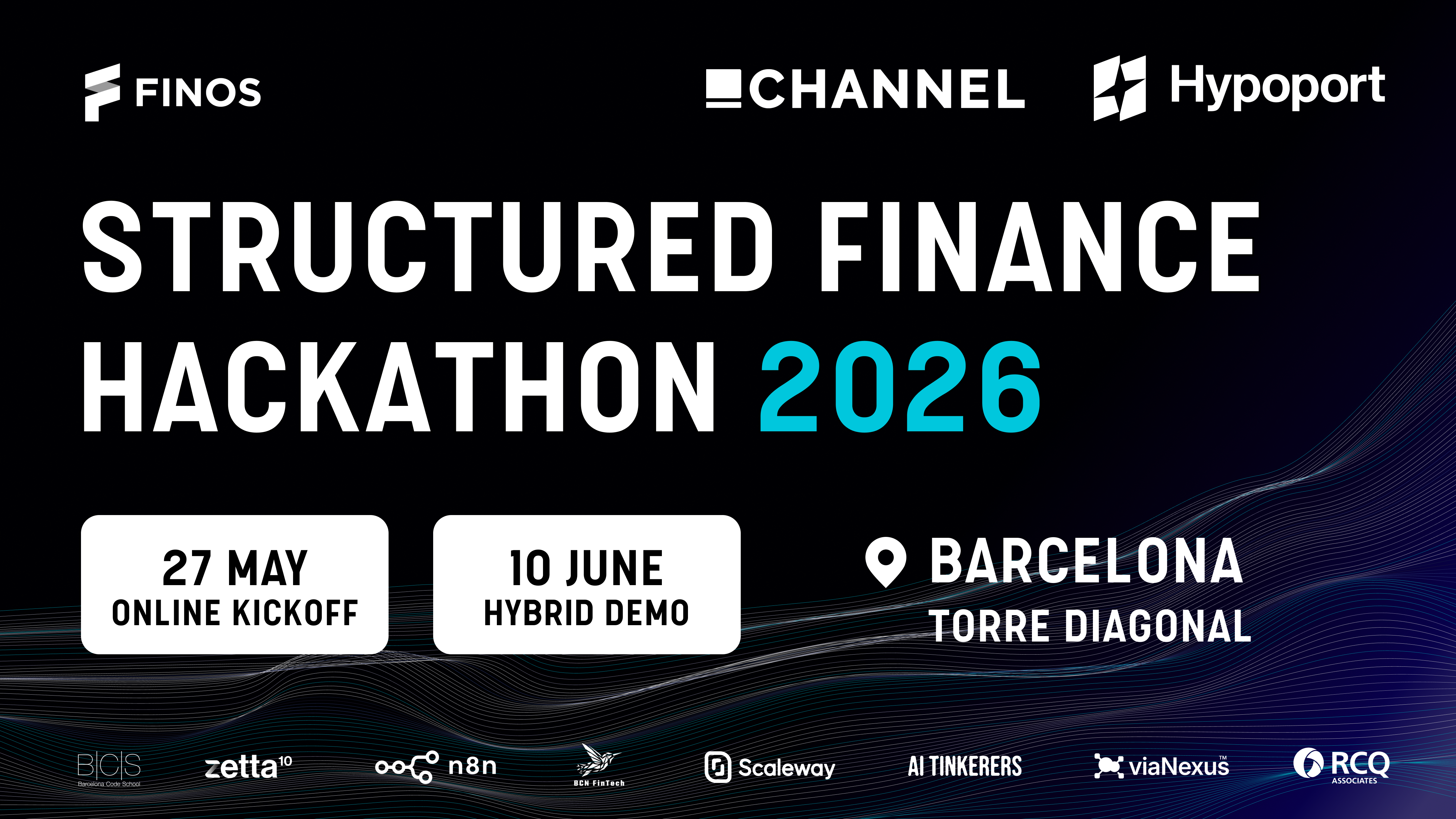
The third edition of the Structured Finance Hackathon brought together more than 80 developers, data scientists, AI builders and finance professionals to tackle some of the industry’s most difficult technology challenges.
Following two weeks of online collaboration, seven finalist teams presented their prototypes on June 10 at Torre Diagonal in Barcelona. Their projects explored how open-source technology, data and AI could improve credit modelling, agentic workflows and the financing of a new generation of physical assets.
Catch the highlights in our event recap video.
Hackathon Winners & Highlights
Innovation was at the forefront of this year’s projects. Here below are listed the best solutions for each hackathon challenge:
World Model for Credit: The Winning team created a framework for training a foundational credit model. The framework includes ingestion, tokenization, training, and downstream evaluation pipelines. After their initial iteration, the team is upgrading its training capabilities leveraging the NVIDIA Incubation program, using eight NVIDIA H100 GPUs, providing 640GB of combined VRAM for a 60-day development period.
Agentic Framework for Structured Finance: This challenge was solved by LoanWhiz and the Hypoport teams. Both teams presented approaches combining deterministic financial components with LLM-powered orchestration. Rather than asking a language model to perform every task, their approaches use specialised and testable components for activities such as extraction, validation, calculation and evidence generation. This hybrid architecture can help improve reliability, traceability and human oversight when AI is used in capital markets workflows. Going forward we will nurture an open-source ecosystem of primitives and explore the opportunity to use Fluxnova, a leading FINOS project, as orchestration engine.
Data Infrastructure Financing: Greyhound responded by addressing the static nature of collateral monitoring. It provided an investor-facing interface for datacenter finance that replaces periodic audits with continuous, source-verified data feeds (demo video). We are seeking trial users to help test workflows and shape the future of these prototypes. If you work for an asset manager, an asset owner or a lender consider joining the Pilot Program.
Expert Panel
Following the project demonstrations, we asked a broader question: What would it take for these prototypes to become trusted, production-grade infrastructure across banks, originators, investors and rating agencies? The discussion was moderated by Edward James (RCQ Associates), featuring:
Daniel Goudsmit, Business Development Lead, Hypoport
Frank Benhamou, Head of SRT at Cheyne Capital and Co-founder of Tranchify
Hanna Sundqvist, Head of Private Credit, Moody’s Analytics
Manolis Manoli, Treasury, N26
The panel explored the importance of data quality, deterministic financial logic, human oversight, explainability and governance when applying AI to structured-finance workflows.
Looking Ahead
Before turning our attention to the next edition, it is worth recognising the cumulative value created by an openly collaborative environment. The 2026 event was the third Structured Finance Hackathon, and we are beginning to see participants build on projects, data models and lessons from previous editions.
For example, CreditGoose, originally developed during the 2025 hackathon, returned this year as part of the Goose training session for quants, risk professionals and front-office practitioners in partnership with OpenRouter and Barcelona Code School. CreditGoose project provided a practical example of how an open source prototype can be reused, extended and connected to new governance and agent-development patterns.
This is the model we want the hackathon to support: Prototype → Open-source project → Community validation → Industry pilot → Production-ready infrastructure
Thank You!
A huge thank you to our sponsors for their support:
Channel Capital sponsored the World Model for Credit challenge, asking teams to explore how payment behaviour – including arrears, cures, defaults, recoveries and prepayments – could be transformed into reusable credit representations. Kris Wilson, Channel Capital’s Chief Operating and Technology Officer, joined us in Barcelona and served on the judging panel. We sat down with him and discussed the practical requirements for adopting AI in private credit, including strong data foundations, governance, human oversight and organisational adoption
Hypoport: Hypoport sponsored the Structured Finance-Native Agent Framework challenge and brought extensive expertise in structured-finance data, reporting and industry workflows. The challenge asked participants to move beyond standalone AI applications and build reusable components (i.e. primitives) for working with prospectuses, ESMA loan-level data, remittance files, trustee reports, waterfall logic and other structured-finance information. Daniel Goudsmit, Business Development Lead at Hypoport, also joined our expert panel to discuss what is required to move AI prototypes into trusted industry infrastructure
FINOS: Fintech Open Source Foundation (FINOS) provided essential best practices for collaboration and AI governance in regulated enterprises. Hackathon participants used the AI Governance Framework (AIGF) as the governance backbone of their projects, bridging the gap between their prototypes and potential future production-level applications.
We are particularly grateful to AI Tinkerers, viaNexus, RCQ Associates, zetta10, n8n, BCN FinTech, and Scaleway, the judges, speakers, instructors and volunteers who contributed their time and expertise for supporting the event and its community.
Most importantly, thank you to every team that was willing to build openly, share its work and demonstrate what the next generation of structured-finance technology could look like.
.png?width=567&height=140&name=086ab-algoritmica-logo%20(1).png)